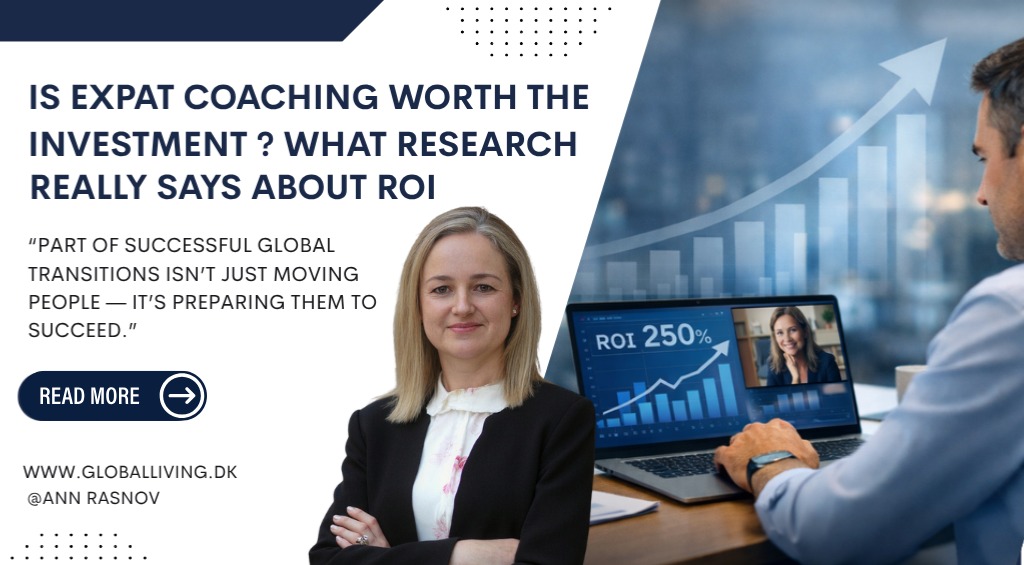
Successful global assignments depend not just on relocation, but on how well professionals adapt, integrate, and perform in new cultural environments.
“Successful international assignments are not defined by relocation — they are defined by how well people adapt, integrate, and perform in a new cultural environment.”
The Real Investment Behind Global Assignments
Expanding into international markets is often seen as a sign of growth and ambition. Organizations send employees abroad to build global teams, strengthen partnerships, and unlock new opportunities. But behind every international assignment lies a significant financial and strategic investment.
Companies typically allocate substantial resources toward relocation, housing, travel, and operational support. These costs can quickly add up, making each assignment a high-stakes decision. Yet despite this level of investment, one critical factor is often underestimated — preparing employees for the cultural realities of working abroad.
This gap between investment and preparation is where many challenges begin. Learn more.
When Global Assignments Don’t Go as Planned
Not all international assignments deliver the expected results. Research shows that expatriate failure rates can vary widely, ranging anywhere from 10% to 80% depending on the region and role. In financial terms, a failed assignment can cost organizations up to $1 million per employee.
What makes this more concerning is that failure is rarely linked to technical capability.
Instead, the root cause is often much more human.
Professionals may struggle to adapt to new communication styles, workplace expectations, or social norms. These challenges are not always visible at the beginning, but over time they affect confidence, performance, and overall effectiveness.
Without the right support, even highly skilled employees can find it difficult to integrate into a new environment.
Why Preparation Matters More Than Experience
There is a common assumption that experienced professionals will naturally adapt when placed in a new country. In reality, global transitions require a very different set of skills.
Moving abroad is not just about performing a role — it is about navigating a completely new cultural landscape.
Professionals must learn how to build trust in unfamiliar environments, understand unspoken workplace dynamics, and adjust their communication styles. At the same time, they are often managing personal transitions, including family adjustments and lifestyle changes.
Without structured guidance, these factors can slow down integration and reduce overall effectiveness.
Research consistently highlights that individuals who receive cultural training and coaching adapt faster, perform better, and experience less stress during international assignments. Read.
Understanding ROI in Expat Coaching
Return on investment in expat coaching is not always immediate or purely financial. Instead, it appears in outcomes that directly influence business performance and long-term success.
One of the clearest indicators of ROI is speed of integration. When employees are better prepared, they spend less time navigating confusion and more time contributing to their roles. This leads to faster productivity and stronger early performance.
Another important factor is risk reduction. Failed assignments are costly, both financially and strategically. By investing in coaching and preparation, organizations can reduce early returns, performance issues, and disengagement. Even a small improvement in success rates can lead to significant savings.
Expat coaching also plays a key role in strengthening global teams. Professionals who understand cultural differences communicate more effectively, build stronger relationships, and collaborate with greater confidence. This leads to better teamwork, improved leadership, and more effective decision-making.
Over time, these benefits extend beyond individual assignments. Organizations begin to build stronger global leadership pipelines, improve talent retention, and create more cohesive international teams. For more information visit.
Why ROI Isn’t Always Visible — But Always Present
One of the biggest challenges organizations face is measuring the impact of expat coaching in traditional terms.
Unlike direct financial investments, its value is reflected in human behavior, team dynamics, and long-term performance. These are not always easy to quantify, but they are critical to the success of global operations.
As international mobility becomes more complex, more organizations are beginning to recognize that preparation is not an optional expense.
It is a form of risk management.
From Cost to Competitive Advantage
Organizations that invest in expat coaching and cultural training are not simply reducing risk — they are building a competitive advantage.
They develop professionals who are adaptable, culturally aware, and capable of working effectively across borders. These qualities are becoming increasingly important in a world where collaboration spans countries, time zones, and cultures.
In this context, expat coaching is no longer just a support function. It becomes a strategic tool for enabling global success.
Conclusion
International assignments will always involve uncertainty. But the difference between success and failure often comes down to preparation.
Organizations that invest only in moving people may achieve short-term outcomes. Those that invest in helping people adapt and succeed are far more likely to see long-term results.
As global mobility continues to evolve, the question is no longer whether expat coaching is worth the investment.
It is whether organizations can afford to operate without it.
Why This Work Matters
Behind every international assignment is more than a business objective. There are individuals navigating change, families adjusting to new environments, and teams learning how to work across cultures.
Expat coaching is not just about improving performance metrics. It is about supporting people through complex transitions and helping them succeed in unfamiliar environments.
When individuals feel prepared and supported, they are more confident, more effective, and more engaged. This not only benefits organizations but also contributes to stronger global collaboration and more meaningful cross-cultural connections.
In the end, global mobility is not just about moving talent across borders.
It is about enabling people to thrive wherever they go. visit.