


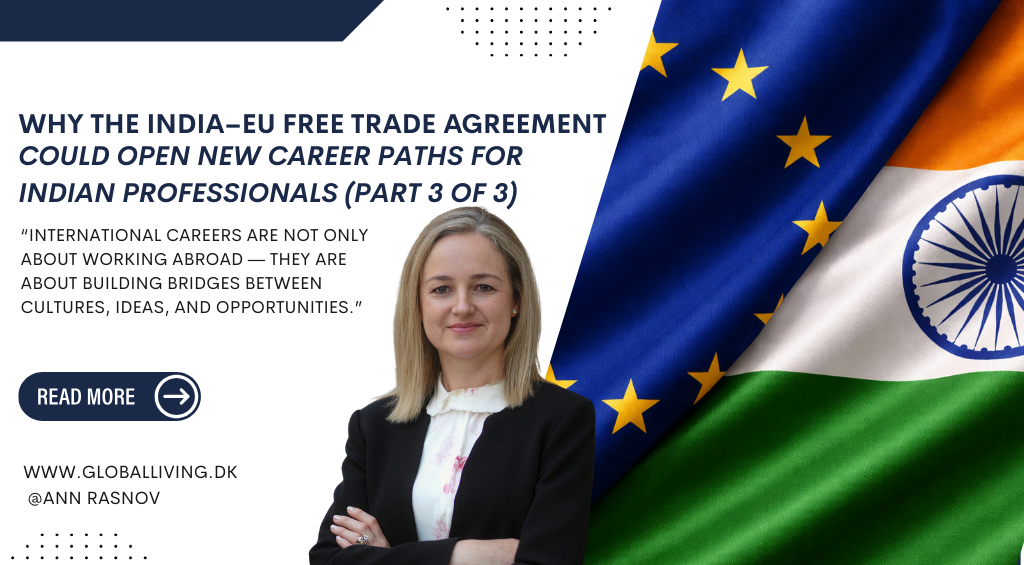
“International careers are not only about working abroad — they are about building bridges between cultures, ideas, and opportunities.”
Industries, Opportunities, and the Human Side of Global Mobility
Over the past few years, the economic relationship between India and the European Union has continued to grow stronger. Businesses are collaborating more, investments are increasing, and industries across both regions are becoming more connected than ever before. India-EU FTA careers are creating new opportunities for Indian professionals seeking to work in Europe. As economic ties strengthen, demand for skilled talent is rising across industries.
One development that could further strengthen this partnership is the proposed India–EU Free Trade Agreement. While the agreement is often discussed in terms of trade and investment, its potential impact on career opportunities and professional mobility could be just as important.
Across many countries in Europe, companies are facing a shortage of skilled professionals in several key industries. As a result, international talent is becoming increasingly valuable. For skilled professionals in India, this may open new doors to work, collaborate, and build careers across European markets.
If you are considering an international move, you may also find it helpful to explore our guide on building emotional resilience when moving abroad, where we share practical insights on managing the personal side of relocation.
Technology and Digital Innovation
Technology is one of the fastest-growing sectors in the global economy, and Europe is investing heavily in digital transformation.
Companies across the European Union are expanding their capabilities in areas such as:
Artificial intelligence
Cloud infrastructure
Cybersecurity
Data analytics
Indian technology professionals already have a strong reputation worldwide for their expertise in IT services, software development, and digital solutions. Many global technology companies already rely on Indian engineers and developers to support complex digital projects.
If the India–EU Free Trade Agreement improves professional mobility between India and Europe, it could make collaboration in the technology sector even stronger.
For many skilled professionals, this could mean opportunities to work on international projects, contribute to cutting-edge innovation, and gain valuable global experience.
Engineering and Advanced Manufacturing
Europe is widely known for its advanced engineering and manufacturing industries. Countries across the European Union are leaders in sectors such as:
Automotive manufacturing
Aerospace engineering
Industrial technology
Renewable energy systems
These industries rely on highly skilled engineers and technical experts who can design, build, and manage complex technologies.
Indian engineers have built a strong global reputation for their technical knowledge and problem-solving abilities. Many international companies already collaborate with engineering professionals from India on large-scale projects.
With improved mobility frameworks under the India–EU Free Trade Agreement, partnerships between Indian engineers and European companies could grow even stronger.
Healthcare and Life Sciences
Another sector where demand for skilled professionals is growing rapidly is healthcare.
Across many European countries, healthcare systems are facing increasing pressure. Aging populations and rising demand for medical services are creating a need for more healthcare professionals.
Hospitals, research institutions, and pharmaceutical companies across the European Union are constantly searching for qualified professionals, including:
Doctors and medical specialists
Nurses and healthcare technicians
Biomedical researchers
Pharmaceutical experts
Healthcare professionals from India are already recognised worldwide for their training and expertise. As collaboration between India and Europe continues to grow, new opportunities may emerge for healthcare professionals who want to work or collaborate internationally.
Why Companies Should Invest in Expat Coaching and Cultural Training
As global mobility increases through agreements like the India–EU Free Trade Agreement, companies must think beyond simply relocating employees from one country to another.
Moving an employee internationally is only the first step. Helping them successfully adapt to a new environment is what truly determines whether an international assignment becomes a success.
This is where expat coaching and cultural training become extremely valuable.
Professionals who relocate internationally often face several challenges, such as:
Adjusting to a different workplace culture
Understanding new communication styles
Navigating cultural differences in professional settings
Supporting their families during the relocation process
Even highly experienced professionals can struggle if they are not prepared for these changes.
For companies, investing in cultural training and support programs can bring several benefits:
• Higher success rates for international assignments
• Faster integration into new teams and workplaces
• Stronger collaboration within global organisations
• Reduced risk of costly relocation failures
• Better employee well-being and retention
Organizations looking to strengthen international assignments can also explore our insights on how to successfully integrate expats into workplace culture, a key factor in long-term global mobility success.
Organizations that support their internationally mobile employees are far more likely to build strong global teams and successful cross-border partnerships.
Conclusion
The proposed India–EU Free Trade Agreement represents an important step in strengthening cooperation between India and the European Union.
While the agreement will certainly expand trade and investment opportunities, its impact on professional mobility and international careers could be equally significant.
By making it easier for skilled professionals to collaborate across borders, the agreement could open new career pathways and allow businesses to access global talent more effectively.
For companies expanding internationally, supporting employees through cultural training and global mobility programs will become increasingly important. At the same time, professionals who develop global skills, adaptability, and cultural awareness will be well positioned to take advantage of the opportunities ahead.
As economic cooperation between India and Europe continues to grow, the movement of talent between the two regions will play a crucial role in shaping the future of global careers.
Why This Work Matters to Me
When people talk about international agreements, the conversation usually focuses on trade numbers, policy discussions, or economic strategies. But behind these big global developments are real people — professionals, families, and communities whose lives change when they move across borders.
Through my work with Global Living, I support internationally mobile professionals and organisations as they navigate the opportunities and challenges of relocating to new countries.
Relocation can be exciting, but it also involves adapting to new cultures, workplaces, and daily routines. Helping people manage these transitions successfully is an important part of building strong international teams and supportive global communities.
My connection to global mobility is also personal. Being married to an Indian husband has given me a deeper understanding of the cultural connections between India and European Union societies. I have seen firsthand how people from different cultures can learn from each other and build meaningful relationships.
For me, global mobility is not just about visas, policies, or international assignments. It is about the people behind these journeys — the professionals building careers abroad, the families adjusting to new environments, and the communities that grow stronger through cultural exchange.
Supporting these journeys is what makes this work truly meaningful.
For a complete perspective on how this agreement is unfolding, revisit Part 1, where we explore its impact on global career opportunities, and Part 2, which focuses on skilled workforce mobility and business implications.